Child Visa
Child Visa in Australia (Onshore and Offshore)

Overview
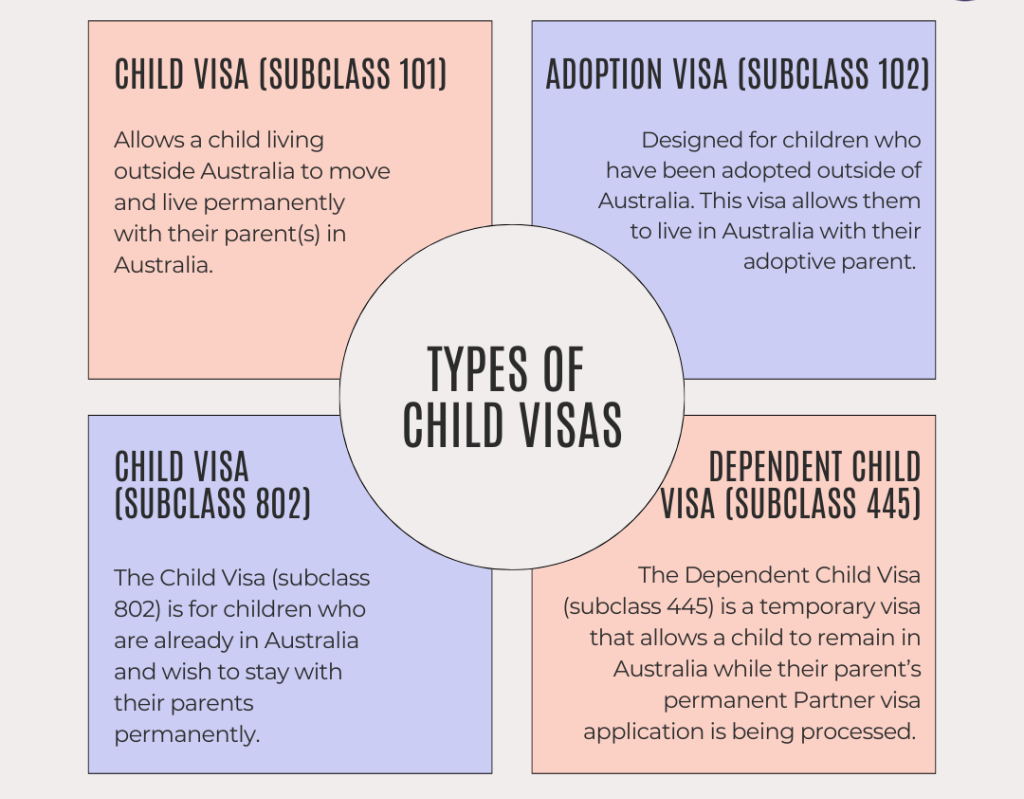
Australia offers permanent Child visas that allow eligible children to live in Australia with their parent(s). The most common pathways are the offshore Child visa (subclass 101) and the onshore Child visa (subclass 802). Which one you use mainly depends on where the child is located when the application is lodged and when the Department makes a decision.
Child visa options
- Child visa (subclass 101) - Offshore application (child is outside Australia).
- Child visa (subclass 802) - Onshore application (child is in Australia).
- Adoption visa (subclass 102) - For eligible adopted children (usually offshore).
- In some cases, a child may also be eligible for a Dependent Child visa (subclass 445) if the parent holds a temporary Partner visa and is waiting for the permanent stage.
Onshore vs Offshore: quick comparison
| Topic | Onshore Child visa (802) | Offshore Child visa (101) |
|---|---|---|
| Where the child must be when lodging | In Australia, and not in immigration clearance. | Outside Australia. |
| Where the child must be when the visa is decided | In Australia, and not in immigration clearance. | Usually outside Australia (plan travel carefully). |
| Bridging visa | A bridging visa may be granted if the child holds a valid substantive visa at time of application. | Not applicable (offshore application). |
| Best for | Children already in Australia (e.g., visiting or studying) who want to stay permanently. | Children living overseas who will move to Australia once granted. |
| Common issues to watch | 'No Further Stay' condition may prevent an onshore application; travel needs planning if on a bridging visa. | Timing travel so the child meets the location requirement at decision time; getting consent/custody documents. |
Benefits of Lodging child visa (802) onshore
- Access Medicare: The child can enroll in Medicare.
- Study rights: You can study full-time in Australia
- Public schooling - Enroll your child in government schools with minimal tuition costs (subject to state and territory rules)
Eligibility (general guide)
A child may be eligible if:
- they are the biological child, adopted child, or eligible stepchild of the sponsoring parent;
- they meet the age and dependency rules
If the child is under 18 at lodgment
If the applicant is under 18 at the time of application, Home Affairs generally accepts that the child is dependent, so formal proof of financial dependency is usually not required .
If the child is 18 to 24 at lodgment
If the applicant is 18–24, they must usually show they are still a dependent child, which often means they:
- are financially dependent on the sponsoring parent for food, shelter and clothes, and
- are not engaged, married, or in a de facto relationship (and have never been married/de facto), and
- are not working full-time, and
- have been undertaking full-time study since turning 18 (or within 6 months / a reasonable time after completing Year 12), leading to a professional, trade, or vocational qualification.
Exception: the “full-time study” requirement does not apply if, at time of application, the applicant is dependent due to being wholly or partially incapacitated for work (disability).
Consent and custody (children under 18)
If another parent or any person has legal rights to decide where the child lives, the Department will generally require written consent for the child to migrate to Australia, or a court order that permits relocation.
Examples of acceptable evidence may include:
- written consent using the Department's consent form (commonly Form 1229), plus ID of the consenting person;
- family law orders or parenting orders showing sole parental responsibility; or
- court orders that specifically allow the child to permanently relocate.
Feeling overwhelmed? We’re here to help.
Our expert team will be at your side at every stage of your partner visa journey, from
understanding eligibility requirements and gathering evidence to submitting your application.
FAQs
Living arrangements / residence
Evidence you live with your parent(s), such as a tenancy/lease agreement, property inspection report, or letter from the landlord/agent.
Rental receipts or bank transaction records showing your parents pay the rent.
Mail to you at the same residential address (e.g., bank letters, government letters).
Financial support (daily living expenses)
Utility bills (electricity, gas, water, internet) showing your parents(s) pay household expenses.
Grocery receipts and everyday spending records paid by your parents(s).
Clothing and personal expenses paid by your parents.
Bank statements showing regular transfers from your parent(s) to you, or evidence your parent(s) pay expenses directly (BPAY, card payments).
Evidence your parents also pay other costs such as tuition fees, course materials, medical/insurance, transport, or entertainment and family activities (e.g., movie/event tickets, dining, travel bookings, holiday itineraries).
Study evidence (if applicable)
Confirmation of Enrolment / enrolment letter from the school, TAFE, college, or university.
Academic transcripts and attendance records (if available).
A letter from the education provider confirming full-time status and ongoing/continuous enrolment.
A study gap of 6 months or less between courses is generally acceptable. If your gap is longer than 6 months, it may still be acceptable, but you should provide a clear explanation and supporting evidence showing there were reasonable or exceptional circumstances (for example: medical issues, compassionate reasons, course availability, visa delays, or family matters). If you’re unsure, you can contact us — we can help prepare a strong submission to the Department.
Yes — but only if the visa is lodged before they turn 25. Applicants aged 18 to 24 can be eligible if they are financially dependent on the sponsoring parent for basic needs (such as food, clothing and shelter) and are enrolled in full-time study. Strong evidence of dependency and enrolment is usually required.
Once they turn 25, they generally will not be eligible under the “dependent child (18–24)” pathway (unless they meet the separate disability/incapacity criteria).
Generally, no. If you lodge before turning 25, it usually won’t be an issue if you turn 26–28 while the application is being processed, as long as you continue to meet the dependency criteria throughout the process.
Usually not. If the child's current visa has a 'No Further Stay' condition, it may block an onshore Child visa application. In some circumstances, a waiver may be possible, but it is not automatic and depends on the visa condition and the facts.
Child visas are lodged as a paper application with supporting documents. After you receive an acknowledgement letter, you may be able to link/import the application into ImmiAccount to track messages and updates (where available).
If the child is in Australia and holds a valid substantive visa at the time of application, they may be granted a bridging visa to remain lawful while the application is processed. Bridging visas can have conditions and travel limits, so get advice before the child leaves Australia.
If the other parent has parental responsibility and does not consent, the Department may refuse the application unless you can provide a court order allowing the child to migrate.
However, after the applicants turns 18 then they do not need to provide the other parent’s consent or the court order.
Under migration policy, if a significant period has passed since lodgement and you have turned 18 or older, the case officer may ask for updated dependency evidence to confirm you still meet the criteria. However, if only a short time has passed since you turned 18, in many cases the Department may not request additional dependency documents.
Book Now
Book Your Consultation